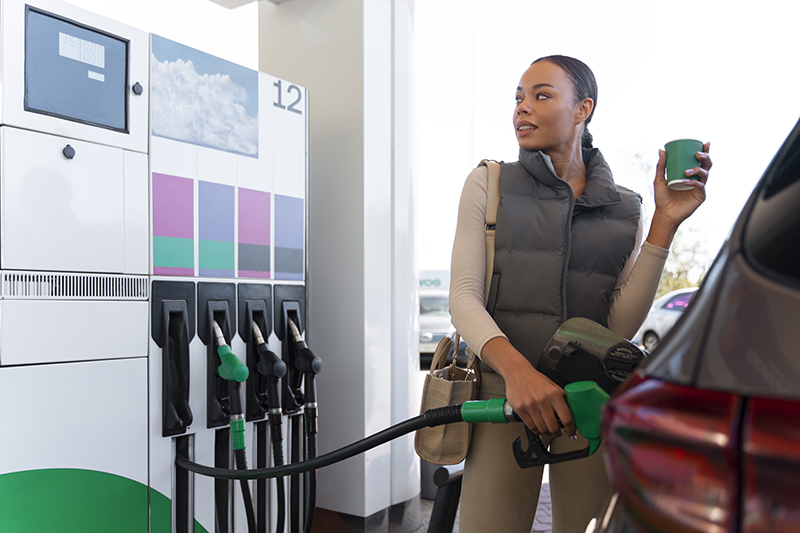
If you've stood at a UK petrol pump recently and hesitated between the green-handled nozzle and the premium one, you're not alone. Since September 2021, E10 has been the standard unleaded petrol across the country — but E5 hasn't gone away. It's still there, usually labelled as "super unleaded," and it's still the fuel of choice for hundreds of thousands of UK drivers.
So which one should you actually be putting in your car? The answer depends on your vehicle, your driving habits, and — especially in 2026 — how much you're willing to pay at the pump.
This guide breaks down everything you need to know about E10 and E5 petrol in plain English, using the latest UK pricing data and government sources.
What Do E10 and E5 Actually Mean?
The names are simpler than they sound. The "E" stands for ethanol — a renewable biofuel made from crops like sugar beet and wheat. The number is the maximum percentage of ethanol blended into the petrol.
E10 contains up to 10% bioethanol mixed with 90% standard unleaded petrol. This is the fuel that comes out of the standard pump at every UK filling station.
E5 contains up to 5% bioethanol mixed with 95% unleaded. Before September 2021, this was the default. Now it's sold exclusively as "super unleaded" or "premium unleaded," typically at 97–99 RON (Research Octane Number) compared to E10's 95 RON.
Both are unleaded petrol. Diesel is entirely unaffected by the E10/E5 distinction.
Why Did the UK Switch to E10?
The move to E10 was driven by the government's carbon reduction targets. By doubling the ethanol content in standard petrol, the Department for Transport estimated the switch would cut CO₂ emissions from road transport by around 750,000 tonnes per year — the equivalent of removing 350,000 cars from the road.
The UK was actually behind much of Europe on this. France, Germany, Finland, and Belgium had already adopted E10 as their standard fuel years earlier. The United States has used E10 as its default petrol grade since 2010.
The policy sits within the broader Renewable Transport Fuel Obligation (RTFO), which requires fuel suppliers to blend a rising proportion of renewable fuels into the petrol and diesel they sell. Increasing the ethanol content from 5% to 10% was considered the most practical, lowest-cost step available without requiring new vehicle technology or major infrastructure investment.
E10 vs E5: The Key Differences at a Glance
Understanding the practical differences between these two fuels matters more now than ever, with petrol prices sitting well above £1.50 per litre across most of the UK.
Ethanol content. E10 has twice the bioethanol of E5. While this is better for emissions, ethanol contains less energy per litre than pure petrol, which affects fuel economy.
Octane rating. E10 is sold at 95 RON. E5 super unleaded is sold at 97–99 RON. The higher octane rating means E5 offers better resistance to engine knock (premature combustion), which matters for high-performance engines and some turbocharged cars.
Price. E5 super unleaded typically costs 8–15p more per litre than standard E10. At some forecourts — particularly branded ones like Shell V-Power or BP Ultimate — the premium can stretch to 20p or more.
Fuel economy. The government's own assessment puts the efficiency loss from E10 at around 1–2% compared to E5. On a 50-litre fill, that's roughly an 80p–£1.60 difference in range. It's real, but for most drivers it's barely noticeable day to day.
Stability. E10 degrades faster than E5 when stored. Ethanol is hygroscopic — it absorbs moisture from the air. If your car sits unused for weeks or months, E10 can cause starting problems and potentially corrode fuel system components. E5 is the better choice for vehicles that aren't driven regularly.
Compatibility. Around 95% of petrol cars on UK roads are fully compatible with E10. All cars built since 2011 are approved for it. E5 is safe for every petrol vehicle — it's the universal option.
Is Your Car Compatible with E10?
This is the single most important question. If your car can't use E10, using it regularly risks genuine engine damage.
The vast majority of cars built after 2011 are fully compatible with E10. Most cars manufactured since the late 1990s are also approved, but this is where it gets less certain. The government estimates that around 600,000 vehicles currently on UK roads are not compatible with E10.
Cars that should stick to E5 include many models built before 2002 (particularly those with carburettors or older fuel injection systems), certain vehicles manufactured between 2002 and 2011 where the manufacturer hasn't confirmed compatibility, classic cars and cherished vehicles, and some motorcycles and mopeds.
The reason is straightforward: ethanol is more corrosive than pure petrol. Higher ethanol concentrations can degrade rubber seals, gaskets, and hoses in fuel systems that weren't designed to handle them. Over time, this leads to leaks, clogged filters, and degraded injectors.
If you're unsure, the government's free E10 compatibility checker at gov.uk lets you look up your specific make and model. Vehicles manufactured from 2019 onwards should also have an E10/E5 label near the filler cap.
One accidental tank of E10 in a non-compatible car won't cause catastrophic damage. You don't need to drain the tank — just use E5 next time. It's prolonged, regular use that causes problems.
The Real Cost Difference in 2026
Fuel prices in the UK have been volatile since late February 2026, when the conflict in the Middle East began disrupting global oil supplies. Threats to shipping through the Strait of Hormuz — which handles around a fifth of the world's oil — sent crude prices sharply upward, and UK pump prices followed.
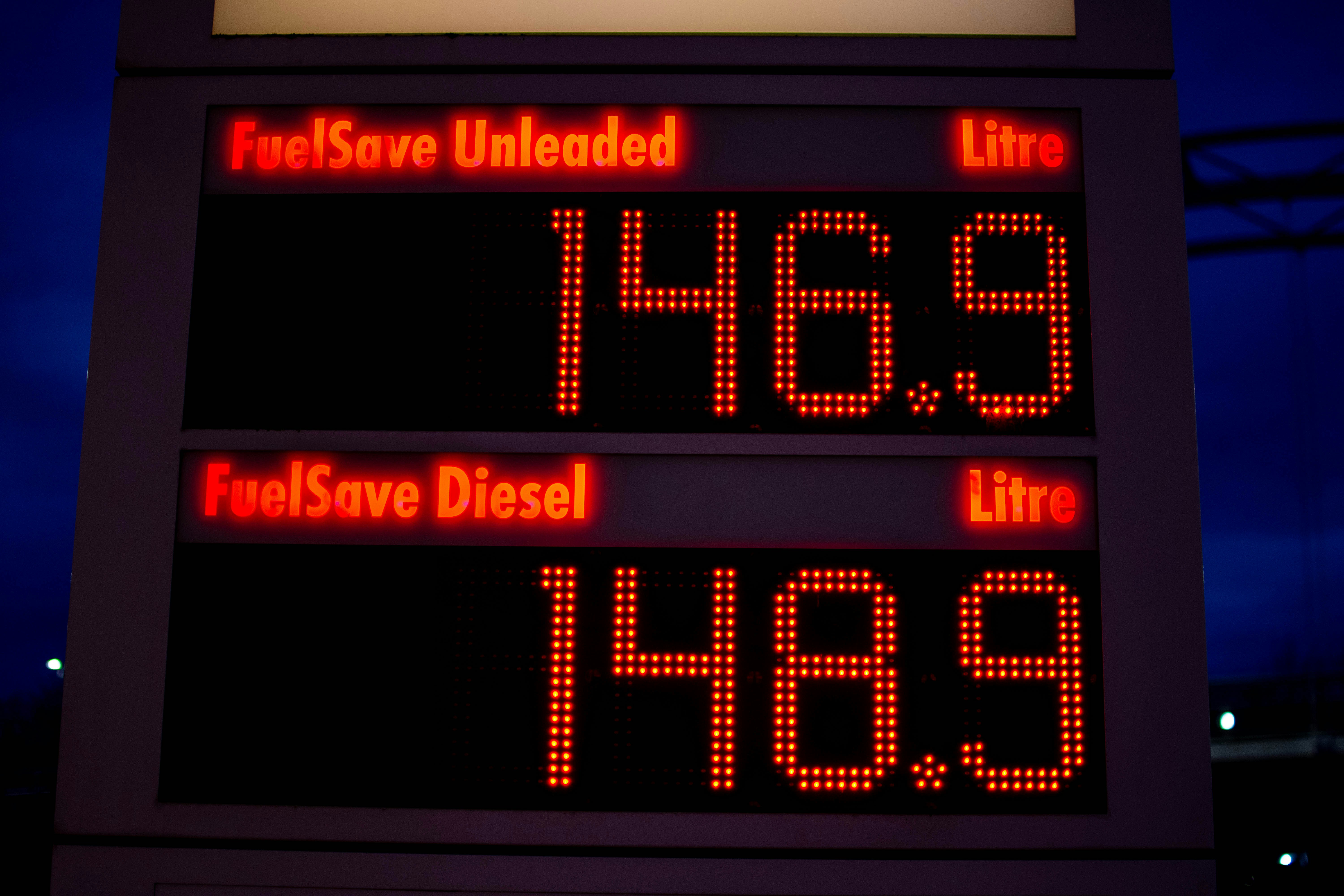
As of early April 2026, average unleaded petrol (E10) prices are sitting around 156p per litre nationally, with diesel significantly higher at around 188p. These are well above the relatively stable levels of 135p that drivers had grown accustomed to through much of 2025.
Super unleaded (E5) is even pricier, with the premium over standard E10 typically running at 10–15p per litre. At branded premium pumps, you could be paying 170p or more for a litre of E5.
For a driver filling a 50-litre tank, the difference looks like this:
- E10 at 156p/litre: £78.00 per tank
- E5 at 168p/litre: £84.00 per tank
- Difference: £6.00 per fill
Fill up fortnightly, and that's roughly £156 extra per year for E5. The 1–2% better fuel economy from E5 claws back a fraction of that — perhaps £20–30 over a year — but E10 remains the cheaper option for anyone whose car can use it.
Fuel Duty: What's Changing and Why It Matters
There's another cost pressure worth knowing about. The 5p per litre temporary cut in fuel duty — first introduced in March 2022 — has been extended several times, most recently to the end of August 2026. However, from September 2026, the government plans to begin gradually reversing the cut, with staged increases through to March 2027, when duty will return to pre-March 2022 levels.
This means every litre of fuel — whether E10 or E5 — will get more expensive in the autumn, regardless of what happens with oil prices. That makes the E10 vs E5 cost question even more relevant for budget-conscious drivers planning ahead.
When Should You Use E5?
Despite costing more, there are situations where E5 is clearly the right choice.
Your car isn't E10 compatible. This is non-negotiable. If the manufacturer or the government checker says your vehicle shouldn't use E10, stick with E5. The repair bills from corroded fuel system components far exceed any savings.
You own a classic car. Vehicles built before the late 1990s were designed for fuel with little to no ethanol. Classic car owners have rightly been cautious, and E5 remains widely available precisely because of this need. The government's original commitment was to guarantee E5 supply for at least five years from September 2021 — putting the theoretical review point around September 2026. However, industry experts and government guidance continue to indicate that E5 will remain available beyond this date, sold as super unleaded at stations offering two grades of petrol.
Your car sits unused for long periods. Seasonal vehicles, second cars, motorhomes — anything that might sit with fuel in the tank for weeks or months is better off with E5. The lower ethanol content means less moisture absorption, less phase separation, and less risk of starting problems after storage.
You drive a high-performance car. If your manufacturer specifies 97+ RON fuel, you need super unleaded regardless of the ethanol question. Many performance-tuned engines are calibrated for higher-octane fuel and won't deliver their full potential on 95 RON E10.
When Should You Use E10?
For the majority of UK drivers — those in modern, everyday cars doing regular miles — E10 is the sensible default.
Your car is E10 compatible and you drive regularly. This covers roughly 95% of petrol vehicles on UK roads. E10 is cheaper per litre, and the minor efficiency loss doesn't outweigh the price saving.
You want the lowest cost per mile. Even accounting for the 1–2% reduction in fuel economy, E10 works out cheaper overall. The maths is straightforward: a 10–15p per litre saving on fuel massively outweighs a 1% drop in mpg.
You want to reduce your carbon footprint. E10 produces less CO₂ per litre burned than E5, thanks to the higher proportion of renewable ethanol. It's a modest contribution, but it's a tangible one.
Can You Mix E10 and E5?
Yes. The Department for Transport has confirmed that mixing E10 and E5 is perfectly safe in compatible vehicles. You'll simply end up with petrol that has an ethanol content somewhere between 5% and 10%. Many drivers already do this without realising — topping up with whatever's available at the nearest pump.
If you accidentally put E10 into a non-compatible car, there's no need to panic or drain the tank. Just fill up with E5 next time.
What About the Future of E5?
This is a question that classic car owners and drivers of older vehicles understandably worry about. When E10 was introduced, the government committed to keeping E5 available for at least five years. That initial window technically closes around September 2026.
However, the picture is reassuring. Government guidance on the GOV.UK E10 explainer page states that E5 will remain available as the super grade for vehicles that need it, with no announced end date. Industry body Fuels Industry UK continues to supply E5 as part of the premium fuel offering. And the commercial reality is that super unleaded remains a profitable product for fuel retailers — they have no financial incentive to drop it.
The realistic outlook is that E5 will continue to be sold as super unleaded for the foreseeable future. What may happen over time is that it becomes slightly harder to find at smaller or single-pump stations, but any forecourt selling two grades of petrol is required to offer E5 as the higher-octane option.
Practical Tips for Saving on Fuel in 2026
Whichever grade you use, there are straightforward ways to reduce what you spend at the pump — and they matter more than ever with prices where they are.
Compare prices before you fill up. Fuel prices can vary by 10p or more per litre between stations just a few miles apart. Use a fuel price comparison tool to find the cheapest local option. Supermarket forecourts (Tesco, Asda, Sainsbury's, Morrisons) are typically 3–8p cheaper per litre than branded stations.
Avoid motorway services. Motorway forecourts routinely charge 10–20p more per litre than town stations. Planning a fill-up before you hit the motorway saves real money.
Drive efficiently. The government's own guidance notes that driving style, tyre pressure, and removing roof racks have a far greater impact on fuel economy than whether you're using E10 or E5. Smooth acceleration, anticipating stops, and maintaining correct tyre pressures can improve your mpg by 10–15%.
Don't pay for E5 if you don't need it. If your modern, post-2011 car runs perfectly well on E10, there's no mechanical benefit to filling up with premium super unleaded. You're paying more for a higher octane rating your engine probably can't exploit.
The Bottom Line
For most UK drivers in 2026, E10 is the right fuel. It's cheaper, widely available, compatible with the vast majority of cars on the road, and contributes — in a small way — to reducing transport emissions.
E5 is the right fuel if your car was built before 2011 and isn't confirmed E10-compatible, if you drive a classic or performance vehicle that needs higher-octane fuel, or if your car sits idle for long periods.
If you're unsure, check the government's E10 compatibility tool, and when in doubt, E5 super unleaded is safe for every petrol car.
With fuel prices as high and as volatile as they are right now, the smartest move any driver can make is to compare prices locally before filling up — whatever grade you need.
This article is regularly updated to reflect current UK fuel prices and government policy. Data referenced includes GOV.UK guidance, Department for Transport impact assessments, RAC Fuel Watch data, and Competition and Markets Authority fuel price monitoring. Always check your vehicle's compatibility before choosing your fuel grade.
Find the cheapest petrol and diesel near you with PetrolFinder.uk.


Comments
Loading comments…